Colonization
Home Who We Are Colonization
What's that in your canoe?
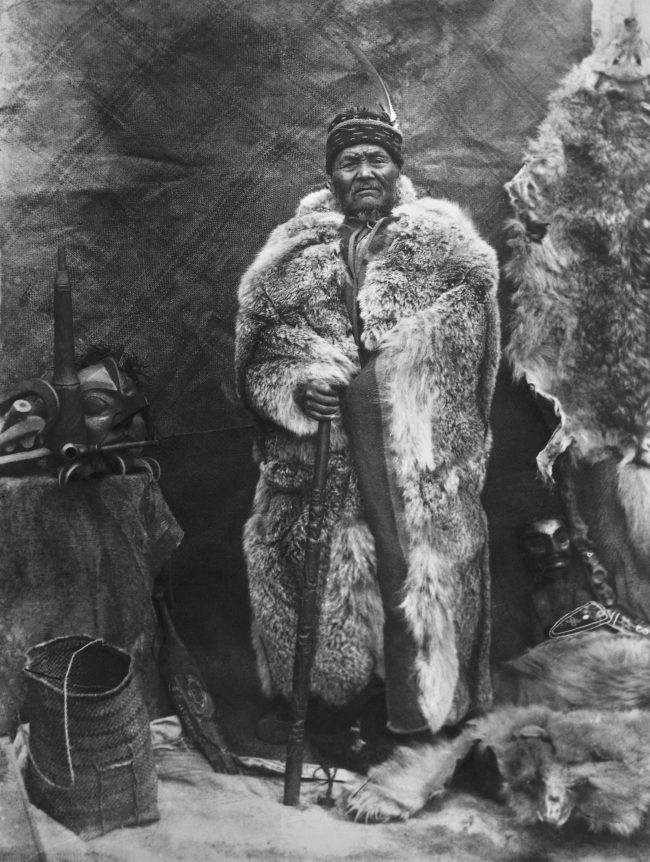
In 1888, government men appeared in Nisg̱a’a territory near Gitlax̱t’aamiks. Sim’oogit Sg̱at’iin met the outsiders and noticed their survey equipment. They announced they were going to measure the land and give some to the Nisg̱a’a.
“How could you give us land that is already ours?,” asked Chief Sg̱at’iin. “These are our mountains and our river.”
Chief Sg̱at’iin aimed his gun at the belly of the lead surveyor, took away their instruments, and sent them packing downstream.
By this time, the government of Canada was using its authority to assume control over the Nisg̱a’a people by entering into partnership with Christian churches. On Nisg̱a’a Lands, missionaries and federal Indian agents came to regard the resistance of the Pdeeḵ (tribes), Wilp (houses), and Simgigat (chiefs) as the most serious impediment to converting and “civilizing” Nisg̱a’a people. Churchmen set up their missions along the riverbank to proclaim an uncompromising message: Accept the terms of the new religion and order or face eternal damnation.
History shows that outsiders often coerced Nisg̱a’a into giving up their regalia and possessions. Some surrendered (or sold) these items freely, as a sign of good faith. While many items were destroyed, missionaries kept or sold some to traders, who in turn sold them to museums and private collectors.
Not only were Nisg̱a’a belongings lost, our way of life was under assault. Outsiders mistook our Pts’aan (crest poles) as idol worship and our Halayt (Spiritual Healers) as sorcerers. Our ceremonies and feast system were banned and our culture and traditions were marginalized. The timeless flow of knowledge and wisdom from one generation to the next was disrupted. Despite determined resistance, some Nisg̱a’a knowledge was lost.
The missionaries gave British surnames to some Nisg̱a’a. Some Nisg̱a’a took Christian first names and used their Nisg̱a’a name as a surname. Sim’oogit Sg̱at’iin took the name “Israel” and became “Israel Sg̱at’iin.” The Canadian government required Nisg̱a’a to keep their father’s surname because they claimed children belonged to their father’s family, not their mother’s. This made no sense to the Nisg̱a’a because we had always traced our descent through our mother’s family.
As for Sim’oogit Sg̱at’iin, he cautioned the missionaries not to say too much against Nisg̱a’a ways.
“You are but a leaf in this country, and I have only to blow with my mouth to send you flying back again to the sea!”
Sim’oogit Sg̱at’iin
1888
Near Gitlax̱t’aamiks