Annual Cycle
Home Our Culture Cultural Practices & Traditions Annual Cycle
Nisg̱a’a people have occupied villages along Ḵ’alii-Aksim-Lisims (the Nass River) hlidaa la’ooy̓ (from time immemorial). The many Nisg̱a’a villages, prior to the imposition of reserves under the federal Indian Act, were occupied seasonally with respect to the place where traditional harvesting was accessed and prepared every year. During the winter months our people maintained their winter villages, accessing small and large game animals, while many Huwilp (clans) carried out their responsibilities and work hosting a Yukw (feast).
DID YOU KNOW
We Move with the Season
As winter comes to a close, the Nisg̱a’a move down river to Fishery Bay to prepare the equipment, supplies, and buildings for the oolichan harvest. When the oolichan season has passed, we move to other fishing grounds in the spring and early summer.
The fishing grounds selected are determined by the Simgigat, Knowledge Keepers, and Elders who are considered experts at knowing where their family fish camps are located, noting past practice and the change in the meandering river. All the fishing village sites are used every year. In the fall, after fish and other winter supplies are prepared, preserved, and stored to sustain the Nisg̱a’a through the long, cold winter, groups of hunters then move on to their traditional hunting grounds or their winter village.
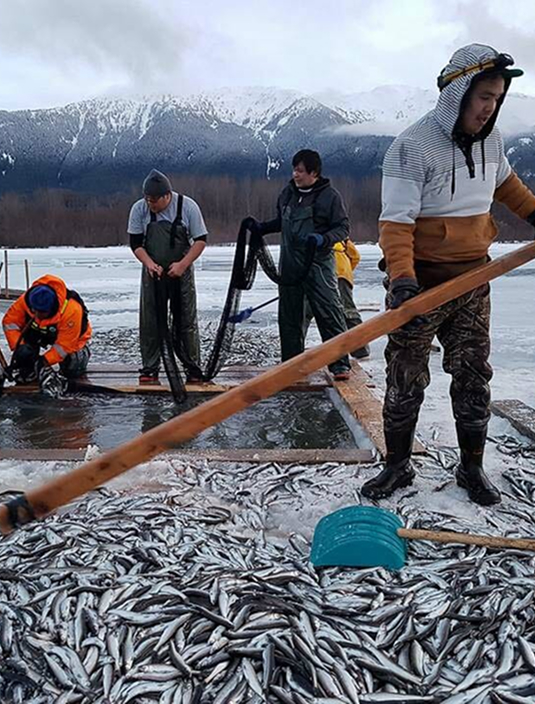
An Enduring Tradition
To this day, our Simgigat and Elders continue to advise us on when and where to access resources, while maintaining the environment and the sustainability of the resources for future generations.